 blog
Famous Tattoo Artists: Styles, Portfolios & Booking
Last Updated: October 22, 2026
Quick Summary
Famous tattoo artists earn their reputation through technical mastery, a recognizable signature style, and a portfolio of healed work that holds up years later. Judge tattoo artists by healed photos, consistent quality, and a style that matches your concept rather than by follower count.
- Fame built on fresh photos does not survive scrutiny; judges and collectors look at healed tattoos.
- Most working artists specialize in two or three styles, and strong portfolios show depth in a narrow lane.
- Check healed photos, line work, shading, composition, and placement variety in any portfolio.
- Ask about deposit policy, waitlist length, and how the artist adapts your idea to the placement.
- Never let an artist cover old ink without seeing it healed and in person first.
Table of Contents
- What Makes a Tattoo Artist Famous
- Signature Styles: Traditional, Realism, Fine Line, and More
- How Tattoo Artist Portfolios Reveal Skill Level
- Tattoo Consultation Questions to Ask Before Booking
- Finding the Best Tattoo Artists in Charlotte
- Tattoo Cover-Up Artists in Charlotte: What to Expect
- Safety, Hygiene, and Aftercare Standards
- Conclusion
- Frequently Asked Questions
What Makes a Tattoo Artist Famous
Famous tattoo artists earn their reputation through technical mastery, a recognizable style, and a portfolio that holds up years after the ink heals. At Canvas Tattoo & Art Gallery, we've seen what separates a genuinely famous tattoo artist from a well-followed one: consistency, not follower count.
The famous tattoo artists who last build three things at once: skill, visibility, and trust. Skill shows in healed work. Visibility comes from awards, conventions, and word of mouth. Trust comes from a clean studio and honest consultations.
Below, we break down what drives fame in tattooing, how to judge a portfolio, and how to book an artist who fits your vision.
Mastery, Accolades, and Industry Influence
Mastery comes first. An artist can post stunning fresh photos, but fame built on unhealed work doesn't survive scrutiny. Convention judges and seasoned collectors look at healed tattoos, line consistency, and saturation years later.
Accolades speed up recognition: studio awards and convention wins give clients a shortcut for judging quality. Industry influence works the same way, artists who teach, judge, or mentor shape the craft, and that reputation travels.
Signature Styles: Traditional, Realism, Fine Line, and More
A signature style makes an artist instantly recognizable and is the fastest filter when choosing who should tattoo you. Style determines how a design is built, how it ages, and whether the artist can execute your idea at all.
Here is how the major styles actually differ in execution, aging, and best use:
- Traditional (American traditional): Bold black outlines, a tight primary palette, and heavy saturation. Designs stay readable for decades, which is why flash-style icons, anchors, swallows, roses, daggers, remain the reference points. Thick lines tolerate sun exposure and skin aging better than most styles.
- Neo-traditional: Keeps traditional's bold outline structure but adds depth, richer color, and more elaborate composition. Line weight varies more, and backgrounds carry as much weight as the subject. It demands stronger drawing skills because the composition must hold together at a larger scale.
- Realism (and hyper-realism): Pushes shading and detail toward photographic using layered pigment and soft-edge blending rather than outline. It's the least forgiving style on aging: fine detail softens first, so artists build in contrast and avoid detail that will blur. Best for portraits and subjects where likeness matters more than graphic punch.
Style tells you whether an artist can execute your idea. A realism specialist may not be right for a bold traditional sleeve, and a fine line artist may not be right for a full back piece.
Neo-Traditional and Black and Grey
Both styles demand strong line work and control over pigment. In a portfolio, look for consistent shading and clean edges in healed photos, those two details separate mastery from a good camera angle.
How to Match a Style to Your Concept
Before you shortlist artists, describe your idea in style terms rather than subject terms. "A portrait of my grandfather" is a realism brief. "A bold eagle on my forearm" is a traditional brief. "A delicate botanical band" is a fine line brief. Once you can name the style, search portfolios for it specifically instead of scrolling a general feed.
A practical matching sequence most collectors follow:
- Name the style your concept belongs to, plus a backup in case the first is impractical for your placement.
- Check healed examples in that style, aging behavior differs by style more than by artist.
- Confirm the artist books that style regularly, not occasionally. A realism artist who does one traditional piece a year is not a traditional artist.
- Ask how the artist would adapt the concept to your placement, because style and body location interact. Fine line on a ribcage and fine line on a forearm are different projects.
How Tattoo Artist Portfolios Reveal Skill Level
A portfolio reveals skill level when it shows healed work across a range of designs, not just the artist's favorite pieces.
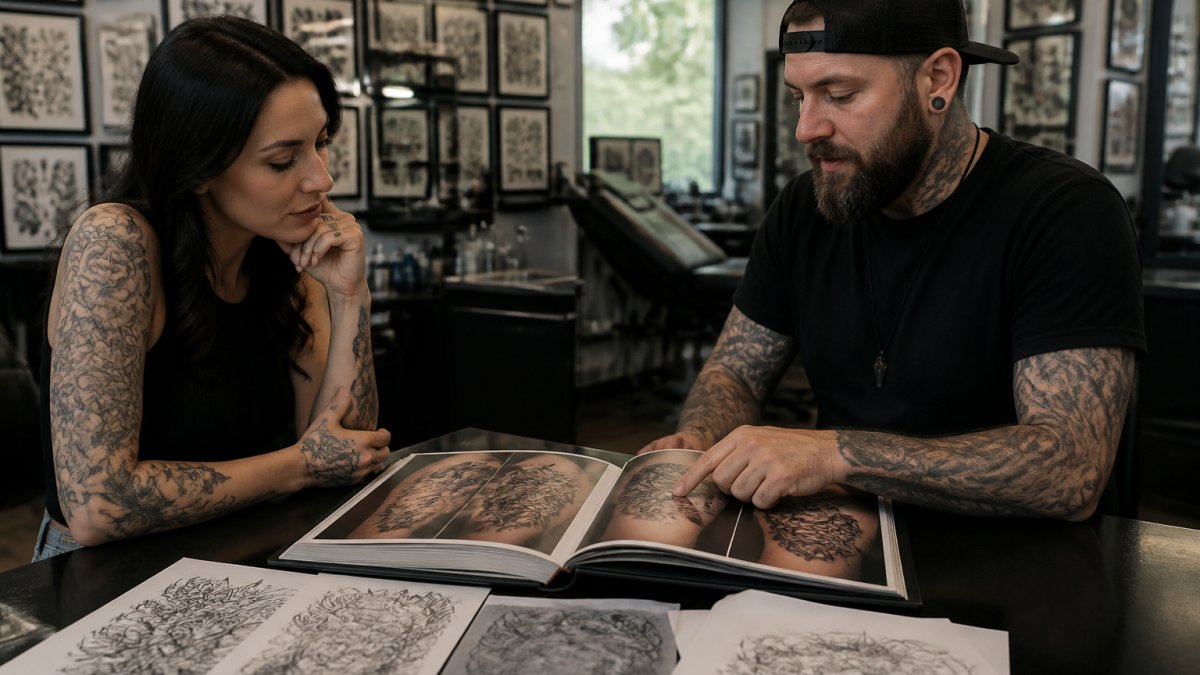
Here is what to check in any tattoo artist portfolio:
- Healed photos: Look for shots taken months after the session. Healed work shows how lines settled, how color held, and whether the design still reads at a distance.
- Range: Depth in one style is a strength; a portfolio that claims every style usually means shallow experience in most of them.
- Line work: Zoom in. Wobbly lines show up fast, and so do lines that were overworked, they tend to blow out and thicken as they heal.
A strong portfolio shows artistic evolution, not a greatest-hits reel.
Reading a Portfolio Like a Collector
Collectors evaluate portfolios in a specific order: healed work only; whether the artist's dominant style matches what they want; evidence the artist finishes large projects, multi-session sleeves and back pieces, because finishing is a different skill from starting; and whether the artist credits collaborators, a signal of professional honesty.
Experienced collectors ignore follower counts and look for three things: healed photos, a consistent style, and a booking process transparent about waitlists and deposits. Fame online means little if the portfolio cannot survive a close look at healed work.
Red Flags in a Portfolio
Most portfolio problems are visible before you ever contact the artist:
- Only fresh, heavily filtered photos. If every image is hours old and edited, you have no evidence of how the work ages.
- No healed work at all. Some artists genuinely photograph poorly healed work, but a portfolio with zero healed images is a gap, not a coincidence.
- Stolen or uncredited images. Reverse-image search a few pieces. If the same photo appears under two artists, walk away.
Matching Specialization to Your Project
The portfolio is also where you confirm specialization. For a realism portrait, look for healed realism portraits, not realism mixed with traditional and fine line samples. For a cover-up, look for healed cover-ups specifically. Specialization matching is the step most clients skip and the one that most reliably predicts satisfaction. An artist whose portfolio is dominated by the style you want is the safest bet, even with a smaller following than a generalist.
Tattoo Consultation Questions to Ask Before Booking
A good consultation answers three things: can this artist execute your idea, what will it cost, and how do you get on the books. Ask direct questions and listen to how the artist responds.
Bring these tattoo consultation questions to your appointment:
- Can you show me healed examples of this style?
- How would you adapt my idea to fit the placement?
- What's your process for design conceptualization and revisions?
- Do you use a stencil, free-hand, or both?
Finding the Best Tattoo Artists in Charlotte
The best tattoo artists in Charlotte combine a strong portfolio, a clean studio, and a style that fits your concept. Start with local reputation, then verify it yourself.
At Canvas Tattoo & Art Gallery, we sit in the heart of NoDa, and we've built our reputation on custom design and cover-up work. We were voted Best Tattoo Shop in Charlotte by Elevate Lifestyle and Queen City Nerve, and named among the Top 50 Tattoo Parlors in America by Big 7 Travel.
How to vet any studio before you book:
- Check reviews for comments on cleanliness and professionalism.
- Ask about the consultation process and whether it's free.
- Confirm the artist specializes in your style.
- Visit in person and watch how the studio runs.
Tattoo Cover-Up Artists in Charlotte: What to Expect
Cover-up work is its own skill. A tattoo cover-up artist in Charlotte must read the old tattoo's shape, color, and density, then design something that hides it without looking heavy or muddy.
Expect a real conversation about what's possible. Dark, saturated old tattoos limit your options. Lighter or faded work gives an artist more room.
One of our clients, Danine Prakash, put it plainly: "Soldier does amazing work. I wanted a cover-up for an old tattoo...
Safety, Hygiene, and Aftercare Standards
Safety and hygiene standards separate professional studios from risky ones. The CDC guidance on tattoo safety and infection control spells out the risks of unsterile equipment, and a professional studio will meet those standards without being asked.
Aftercare decides how the tattoo heals. The FDA information on tattoo inks and aftercare notes that reactions can show up well after the session, so report anything unusual to your artist and a doctor.
Book with an artist who explains the healing process up front, a mark of professionalism that protects your skin and your investment.
Conclusion
Finding famous tattoo artists who live up to the hype takes more than scrolling reviews: a portfolio full of healed work, a style that fits your idea, and a studio that treats safety as non-negotiable.
At Canvas Tattoo & Art Gallery, we offer a free consultation, a personalized design process, and expert cover-up services in a clean, welcoming NoDa studio.
Ready to talk through your idea? Book a free consultation with Canvas Tattoo & Art Gallery and start your piece with an artist who gets your vision.
Frequently Asked Questions
What should I look for when choosing a tattoo artist in Charlotte?
Start with the artist's portfolio to confirm their style matches your vision, then check that the studio follows strict hygiene standards and uses sterile, single-use equipment. Read client reviews for professionalism and communication. Ask about their consultation process and whether they specialize in your desired style, such as realism or fine line. A free consultation lets you discuss your idea, placement, and budget before committing, which lowers the risk of a mismatch.
How can I tell whether a tattoo artist's portfolio is right for my style?
Look for healed photos, not just fresh tattoos, because healed work shows how line work, shading, and pigment settle over time. Match the portfolio's dominant style to what you want: realism, neo-traditional, black and grey, or fine line. Check consistency across multiple pieces rather than one standout image. If your idea is a mashup of styles, ask during your consultation whether the artist has executed similar combinations and can show examples.
How do I choose an artist for a tattoo cover-up?
Cover-ups require an artist who can work with existing pigment, scar tissue, and placement constraints. Ask to see before-and-after photos of cover-ups they have completed, ideally healed. During your consultation, discuss whether the old tattoo can be covered directly or needs lightening first. Experienced cover-up artists will explain design options, color choices, and realistic outcomes rather than promising a perfect result. Book a consultation to confirm their approach fits your goals.
How do you book a consultation with a tattoo artist?
Most studios offer online booking or a contact form, and many provide free consultations. Prepare reference images, your preferred placement and size, and any style notes before you go. Ask about waitlists, deposit requirements, and how design revisions work. A good consultation should cover pricing factors, aftercare, and the healing process so you leave with clear next steps rather than pressure to book on the spot.